
The Thick of It
Everyone agreed. Nothing moved. The force that holds organisations still has a name.
The Room
The most expensive thing we did that quarter was a free workshop.
I went to it with a stinking cold. I should have been in bed. But the whole leadership group was flying in, board members among them, and there are days you do not miss no matter what your body is telling you.
That instinct, the one that overrode the fever, is worth noticing. Nobody made me get on the plane. I made me.
This was back when there was still travel. Proper travel, the pre-COVID kind, when budgets were generous and nobody thought twice about flying senior people across a continent for a day in a room. We came in from across the region. Agencies in half a dozen countries, each sending its leaders, all converging on one city for a single day of thinking about the future.
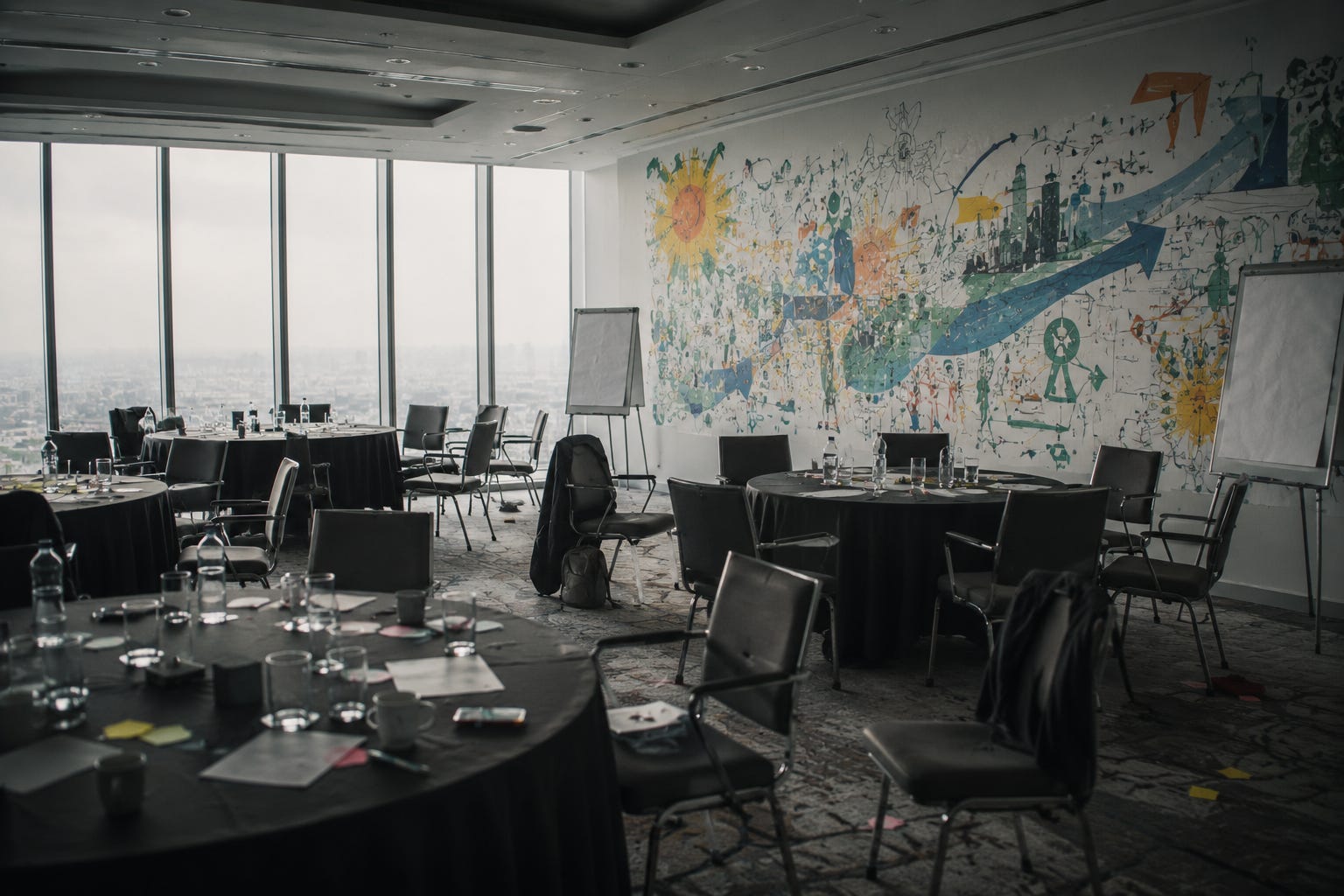
The consultancy hosted us at the top of their building, on a purpose-built events floor designed to make visitors feel they had arrived somewhere that mattered. They were running the day for free, the cost carried somewhere in a corporate budget none of us could see. A free day now, a conversation about fees later. Everyone understood the arrangement without a word of it being said.
Add up the flights, the hotels, the dinners, the time of thirty senior people across two days including travel. That is how a free day becomes the most expensive thing in the quarter.
For a lot of the group this was unfamiliar ground. They were good at their jobs, confident in their own offices, used to being the most assured voice in their own market. Here that counted for nothing. Most had one colleague with them, two at the outside. Everyone else was a name they knew from a screen, a face that lived inside a video call, now standing in front of them at full size holding a coffee. And the board members they had only ever seen two rungs above them were suddenly close enough to talk to, which was worse.
So you could watch the calculations start. Who to stand near. When to speak. How to be useful in front of the people who decided things. Nobody was being dishonest. Everybody was performing. That is what the room was for.
I knew the performance because I had been responsible for plenty. I was a board member here, a senior voice. I had run a day like this myself a year before. I wanted today to go well, and I wanted to be seen to want it.
The day was excellent. I have sat through many of these and this was the best run I had seen. The facilitation was sharp. The breakouts actually worked. Someone photographed every flipchart and the images were on the big screen before we had sat back down. The big issues got named and storyboarded and projected and argued over. There was even an artist along one wall, drawing the whole thing as it happened, and by late afternoon she had turned a day of talk into a single beautiful picture of where the business could go.
We ended on promises. Each of us owning something out loud, in front of the board, in front of each other. Then we went to dinner, and then we went on somewhere after dinner, the way you did in those days. That was where the real bonding happened. Not over the vision on the wall but over the drinks afterwards, the talk getting louder and warmer the later it got. The drinks did more for us as a group than anything on the walls upstairs.
And I knew that nothing would change. Things would be exactly the same. Nobody would keep their promises.
Not because I was wiser than anyone in the room. Because I had stood where they stood a year earlier, made the same promises in the same room, and watched what came afterwards. Which was nothing. No structure to hold the promises. No one whose job it was to ask, in six weeks, whether any of it had moved. Worse than nothing, in fact. Something corrodes. Every broken promise takes a little confidence with it. Confidence in the leadership that convened the day. Confidence in each other, as a group of people who could get something done together. The lesson everyone absorbs without anyone teaching it, that this is what these days are. You fly in. You talk. You drink. You fly home. Then you go back to your desk and the desk has not changed.
A few days later somebody posted the artist’s drawing on LinkedIn. It did well.
That was the only thing that ever left the room.
Drama vs. Erosion
You will know the other Thick of It. The television one. Malcolm Tucker in a corridor, taking a minister apart, a whole department lurching from disaster to disaster at full volume. They made four series and a film out of it. You can do that, because that kind of dysfunction is gripping. Loud, fast, quotable. Things happen. Bad decisions get made at speed and the wreckage arrives by Tuesday.
Nobody will ever make a television programme about the room I have just described.
There is nothing to film. No shouting, no scene, no moment you could point a camera at. Just thirty capable people, a good day, and an organisation quietly declining to change. The damage does not arrive by Tuesday. It arrives over years, so slowly that no single day looks like the day it happened.
That is the thick of it I mean. Not the chaos that makes good television. The erosion that makes none. No single day looks like the day it happened. They never do.
Just Tuesday
The strategy day that produces nothing that survives the train home. The decision delayed three weeks, then made worse than the first instinct. The meeting where everyone nods and nothing moves. The agreed action with no owner. The transformation deck, boxes and arrows and connectors, weeks to build, an hour to present, agreed by everyone, changing nothing. The project that has been six months from launch for two years. The pre-meeting to align before the meeting, and the pre-meeting before that. The brilliant idea that dies in the corridor between the conversation and the room. The CRM bought, configured, trained on, championed from the top, and quietly never used. The annual brand review whose dense, beautiful slides turn out, when you check, to be last year’s slides with the dates changed, and nobody in the room has noticed. The reorg that arrives every year like a season, boxes redrawn, names moved between the boxes, sold as transformation, actually a shift in power, the work carrying on exactly as before. The ship is not sinking. It is steaming in a circle while the furniture gets moved. The cross-functional initiative that launches as a mandate and decays into a monthly status call nobody prepares for. The town hall question that gets a non-answer and never gets asked again. The competitor who moves while you are still in committee. The new values on the wall above people behaving the old way. Another offsite. Another deck. Another year.
None of these is an event. That is what makes them invisible. No single one is worth a conversation on the way home. They are just Tuesday. And then another Tuesday. And the accumulation of Tuesdays is the thing nobody is measuring.
I tried to beat it once with everything done right. A large consumer brand discovered, in a board meeting, that one of its divisions had no digital strategy. Within a week I had been hired to deliver one. Nobody could say what it was meant to achieve, an irony in a business whose favourite phrase was: what is the exam question? So I found the questions. Seven problems, agreed with the head of the division, pinned to a meeting-room wall where nobody could unsee them. Diagnosis right. Agreement secured. Authority granted, or so it appeared. Over the next six months I was edged out anyway. Not by a decision. By a hundred small acts of self-protection from the people whose territory those problems touched, each act sensible, each comfortable, all of them pointing the same way. Culture eats strategy for breakfast, the saying goes. I watched it eaten. The project ended where these things end. A Big Four firm was hired to say what I had already said.
Everything right. Nothing moved. That is the force. Seeing it clearly is not the same as being able to shift it.
The Field
It has a name. You have met it before in these pages, working at a smaller scale.
Institutional Gravity is what I called the force that re-routed my instinct before Joel ever walked into that meeting. The accumulated weight of small instructions. Pick your battles. Not the right time. That’s not how we do things here. A pull, steady and almost imperceptible, drawing one leader toward compliance until the gap between what they see and what they act on grows to the size of a career.
That was Gravity acting on one person. Now multiply it. Every person in the building is being pulled the same way at once. Toward the familiar pattern, the safe response, the path that does not make the Machine uncomfortable. Thirty people in an offsite, three thousand in a company, each individually edited toward the existing shape of things. No single pull is strong. Added together they hold everything still.
Institutional Gravity is the pull of everyone, at once, toward the way things already are. No one exerts it. Everyone transmits it. And it is strong enough to hold an entire organisation still.
Gravity operates through a field. So does this. A field generated by all working things, which nobody can wield, and whose only power is to stop movement. That is the word I will use from here. The Field.
The thinkers got here first, and they were not gentle about it.
Donald Schön saw it half a century ago and named it Dynamic Conservatism. Institutions do not drift toward sameness. They fight for it. He wrote of:
“the very great unlikelihood that institutions will undertake their own change of state.”
Donald Sull watched good companies respond to disruption by accelerating the very formula that was failing them. He called it Active Inertia:
“an organization’s tendency to follow established patterns of behavior.”
Bromley and Powell found the modern strain. Organisations that implement endlessly, the programmes, the metrics, the reviews, while all that activity stays disconnected from any outcome. They called it, with academic restraint, a gap between means and ends. Motion without movement.
You have sat in the rooms where their research comes true.
The cost is on the record.
One manager or administrator for every 4.7 workers.
More than $3 trillion a year in lost output from excess bureaucracy in the US alone. Around 17% of GDP.
Almost nine in ten transformation programmes falling short of what they set out to do.
And the people at the very top can see it. Andy Jassy, who runs Amazon, complained publicly of pre-meetings for the pre-meetings. Doug McMillon, who ran Walmart for over a decade, called bureaucracy a villain. Jamie Dimon, who runs JPMorgan, the biggest bank in the world, calls it a disease. Three of the most positionally powerful executives alive, describing a force inside their own companies in the language of enemies and illness. If authority could shift it, theirs would.
One more number. Gallup now finds only a fifth of the world’s employees engaged in their work, the lowest in five years, at a cost it puts at ten trillion dollars. The Machine reads that as a motivation problem. Read it again with Institutional Gravity in view. That is what a workforce looks like when everyone has privately concluded that pushing does not move anything.
Seeing it clearly is not the same as being able to shift it. You knew that already. Now you know it goes all the way up.
The Evidence
Which brings us to your exhaustion.
You have been reading it as a verdict. Most leaders do. I should be able to move this. Other people seem to manage. Perhaps I have lost something I used to have. The reading feels like honesty, even humility. It is neither. It is just wrong.
Look at what you have been pushing against. Institutional Gravity. A field generated by everyone at once, strong enough to hold whole organisations still. Researchers have been naming it for half a century. Some of the most powerful executives alive have failed to shift it. You have been straining against that. Daily. For years. Often without knowing it was there, because it is precisely the kind of force that does not announce itself.
Of course you are tired.
The tiredness is not a verdict on you. It is a measurement. It is what a person registers when they push against something invisible and real. Your exhaustion is evidence. Evidence that the Field is real, and evidence that you have not stopped pushing. The ones who stopped are not tired. They are comfortable.
There is a sentence you have said, or swallowed, a hundred times. On the train home. After the meeting that nodded and moved nothing. In the corridor where the idea died.
Everything is harder than it needs to be.
You thought it was a complaint. It never was. It was the most accurate observation you have made about your organisation, and you made it without instruments, against the pull of a force whose whole nature is to go unnoticed. It was a finding.
You were right.
The Door
The drawing is still out there somewhere. A beautiful picture of a future that never happened, surfacing now and then in somebody’s feed, collecting the odd like from people who were never in the room.
I used to think of it as a souvenir. I think of it now as evidence. Proof of how much talent, money and goodwill Institutional Gravity can absorb without moving an inch.
So here is where we are. The friction has a name. You can see it now, and you can stop reading your exhaustion as a verdict on yourself. That much is real, and it matters more than it sounds.
But the naming changes nothing else. The Field will still be there tomorrow morning, in the first meeting and the pre-read. The desk has not changed. And you will go back and push anyway, because that is who you are.
Which leaves the question this essay cannot answer.
Not whether Institutional Gravity is real. You have felt it for years.
The question is what the pushing has done to you. Where the cost of all that invisible straining gets stored, and what carrying it has quietly been doing to the person who carries it. Nobody told you it would feel like this.
That is the next essay. The Pain Itself. A story of chickens.
Related Reading
The moment Institutional Gravity got its name: How I Became Domesticated
The full anatomy of the forces: The Domestication of Leaders
The way back: Recognise. Refuse. Reclaim.